
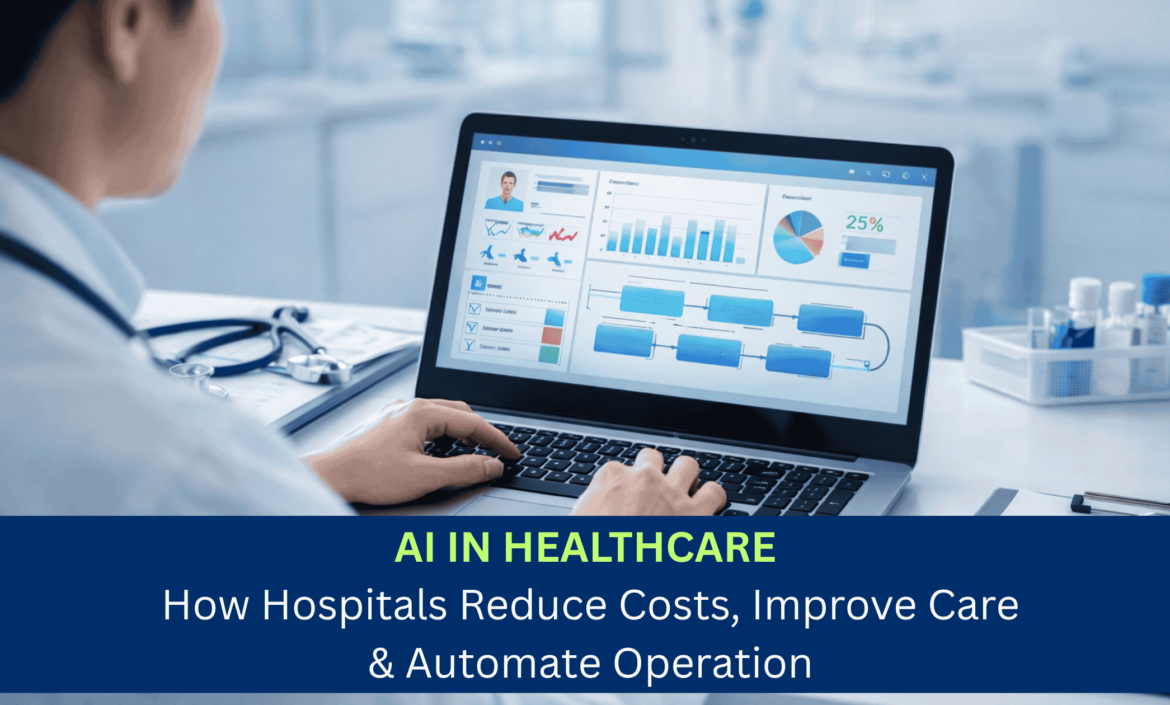
AI in healthcare is becoming essential as healthcare systems face constant pressure from rising operational costs, increasing patient expectations, and growing complexity across systems. Traditional approaches are no longer enough to keep up.
This is where AI is creating a real shift.
From streamlining operations to enhancing clinical decisions, AI is helping hospitals move faster, work smarter, and deliver better outcomes—without increasing overhead.
Artificial Intelligence in Healthcare: A Shift from Reactive to Proactive Care
The real value of artificial intelligence in healthcare lies in its ability to turn data into action.
Hospitals generate massive volumes of data every day, patient records, diagnostics, billing, and operational workflows. But without the right systems, this data often sits in silos.
AI changes that.
Instead of reacting to issues after they occur, hospitals can now:
- Identify risks earlier
- Predict patient needs
- Optimize staff and resource allocation
- Reduce delays across departments
This shift from reactive to proactive care not only improves outcomes but also drives measurable cost efficiency.
AI Applications in Healthcare That Are Driving Real Impact
The impact of AI applications in healthcare goes beyond innovation, it’s about solving everyday operational challenges that slow down hospitals.
1. Intelligent Workflow Automation
Manual processes across departments, like patient intake, documentation, and approvals, consume valuable time.
AI-powered systems can:
- Automate repetitive administrative tasks
- Reduce human errors
- Speed up end-to-end workflows
This allows healthcare teams to focus more on patient care rather than process management
2. Smarter Clinical Decision Support
AI helps clinicians make faster, more accurate decisions by analyzing large datasets in real time.
It can:
- Detect patterns in medical data
- Support early diagnosis
- Recommend treatment pathways
This leads to improved patient outcomes and more confident decision-making.
3. Predictive Analytics for Resource Planning
Hospitals often struggle with resource allocation, staffing, beds, and equipment.
With AI:
- Patient admission rates can be predicted
- Resource demand can be optimized
- Bottlenecks can be reduced before they occur
This ensures smoother operations and better patient experiences.
4. Revenue Cycle Optimization
Billing inefficiencies and claim denials directly impact hospital revenue.
AI-driven solutions can:
- Identify billing errors early
- Automate claims processing
- Reduce delays in reimbursements
This improves cash flow while lowering administrative burden.
5. Enhancing Patient Engagement
AI-powered chatbots and virtual assistants are transforming patient interaction.
They can:
- Handle appointment scheduling
- Answer common queries
- Provide real-time support
This improves patient satisfaction while reducing workload on staff.
How AI in Healthcare Reduces Costs Without Compromising Quality
Cost reduction in healthcare isn’t about cutting corners, it’s about eliminating inefficiencies.
AI helps hospitals:
- Reduce manual workload
- Minimize operational delays
- Lower error rates
- Optimize resource utilization
The result?
Higher efficiency, lower costs, and better care delivery, all at the same time.
The Real Challenge: Bridging the Gaps Between Systems
While many hospitals adopt advanced tools, the real challenge lies in connecting them effectively.
Disconnected systems often lead to:
- Workflow inefficiencies
- Data inconsistencies
- Delays in decision-making
AI delivers the most value when it’s applied across systems, not in isolation.
Frequently Asked Questions:
1. What is AI in healthcare and how is it used?
AI in healthcare refers to using intelligent systems to analyze data, automate processes, and support decision-making. It’s commonly used in diagnosis, patient care, workflow automation, and hospital operations to improve speed and accuracy.
2. How does AI reduce costs in healthcare?
AI reduces costs by cutting down manual work, minimizing errors, and improving efficiency across operations like billing, staffing, and patient management. It helps hospitals do more with fewer resources.
3. What are the most common AI applications in healthcare?
Some of the most common AI applications include clinical decision support, predictive analytics, medical imaging analysis, chatbots for patient support, and workflow automation in hospital operations.
4. Is AI in healthcare safe and reliable?
AI is reliable when used alongside human expertise. It supports doctors and staff by providing insights, but final decisions still rely on medical professionals, ensuring safety and accuracy.
5. How can hospitals start using AI?
Hospitals can start by identifying areas with repetitive tasks or inefficiencies, like billing or patient workflows. From there, they can implement AI solutions step by step to improve operations without major disruption.
Ready to See What AI Can Do for Your Operations?
If your organization is looking to:
- Reduce operational costs
- Improve workflow efficiency
- Enhance patient care
Now is the time to take the next step.
Let’s explore how AI can simplify your operations and unlock measurable impact.
Reach out to Athena Global Technologies (Healthcare Automation Solutions) for a quick conversation on where you can start.