
The Reality No One Talks About
Most insurance companies don’t have a revenue problem.
They have a cost problem.
Claims take too long.
Teams are overloaded.
Systems don’t talk to each other.
And the result?
Millions lost every year — not because of market conditions, but because of inefficient operations.
What’s interesting is this:
The companies that are solving this aren’t hiring more people.
They’re doing something else.
They’re using AI — not as a buzzword, but as a cost-cutting engine.
Where Insurance Companies Actually Lose Money
Let’s strip away the theory and look at reality.
1. Claims Processing Is Still Manual
In many companies, claims still involve:
- Emails
- PDFs
- Manual verification
This slows everything down and increases dependency on large teams.
2. Fraud Slips Through the Cracks
Fraud isn’t always obvious.
It’s hidden in patterns — repeated claims, unusual behavior, small inconsistencies.
Humans miss this.
AI doesn’t.
3. Legacy Systems Create Invisible Costs
Old systems don’t just slow things down.
They:
- Increase maintenance cost
- Limit scalability
- Create dependency on manual workarounds
4. Decision-Making Is Slower Than It Should Be
Underwriting, approvals, risk analysis — all take time.
And in insurance, time directly impacts cost.
So, Where Does AI Actually Help?
This is where most content gets vague. Let’s keep it practical.
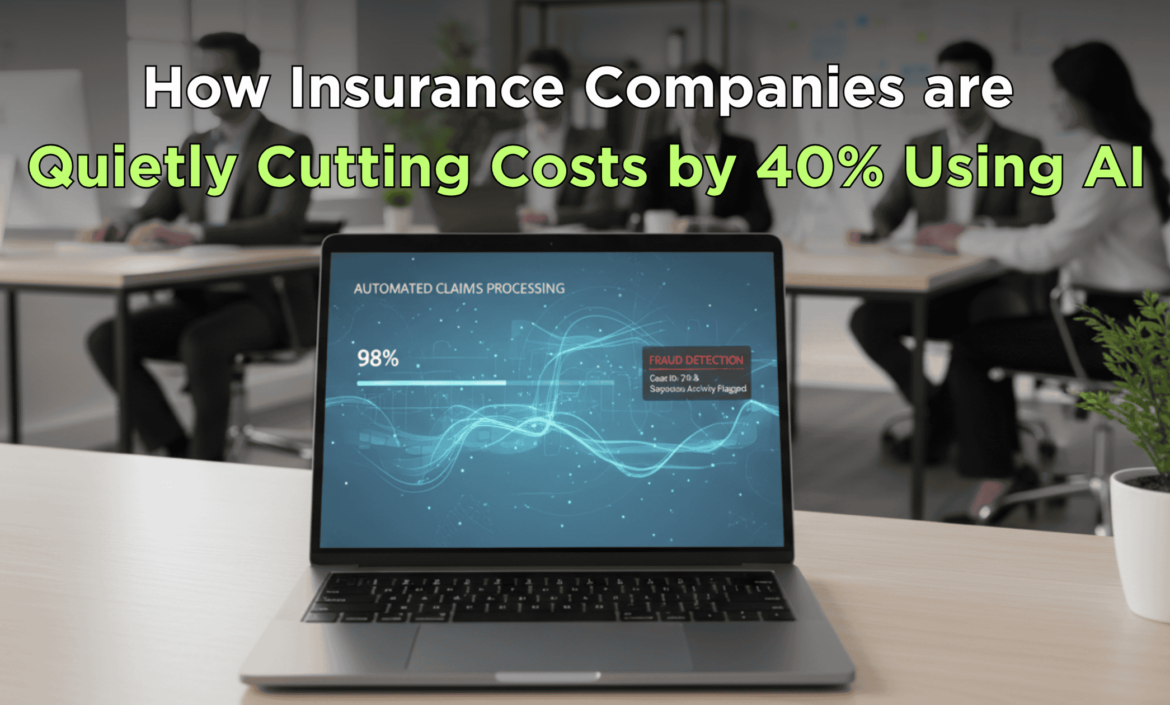
Claims Processing — From Days to Minutes
Instead of:
- Reading documents manually
- Cross-checking policies
AI can:
- Extract data instantly
- Validate claims
- Flag inconsistencies
What changes?
- Faster settlements
- Smaller teams needed
- Lower operational cost
Fraud Detection — Catching What Humans Miss
AI looks at patterns across thousands of claims.
It doesn’t rely on rules.
It learns behavior.
That means:
- Early fraud detection
- Fewer false approvals
- Direct savings
Underwriting — Faster and More Accurate
Risk assessment becomes:
- Data-driven
- Instant
- Consistent
Which leads to:
- Better pricing
- Reduced errors
- Improved margins
Automation of Routine Work
A large part of insurance operations is repetitive:
- Data entry
- Customer queries
- Policy updates
AI handles this quietly in the background.
The result:
- Teams focus on high-value work
- Operations scale without increasing cost
What Does “40% Cost Reduction” Actually Mean?
It doesn’t come from one change.
It comes from multiple small improvements:
- Fewer manual processes
- Faster turnaround times
- Reduced fraud
- Better decision-making
Individually, each saves 5–10%.
Together, they create a massive impact.
How Smart Insurance Companies Approach This
They don’t try to “implement AI everywhere.”
They start here:
Step 1: Identify the Most Expensive Bottleneck
Usually claims or operations.
Step 2: Fix One Process First
Not everything — just one high-impact area.
Step 3: Measure Results
Cost saved, time reduced, efficiency gained.
Step 4: Scale Gradually
Expand only where ROI is proven.
Where Most Companies Go Wrong
Let’s be honest — this is where projects fail.
- Trying to replace entire systems
- No clear ROI goal
- Overcomplicating implementation
- Choosing tech before understanding the problem
AI is not the solution.
Clarity is. AI is just the tool.
Why This Matters Right Now
The insurance industry is changing faster than most realize.
Companies that:
- Reduce costs
- Improve speed
- Deliver better customer experience
will dominate.
Others will struggle — not because they lack customers, but because they can’t operate efficiently anymore.
How Athena Helps Insurance Companies Do This
Most vendors will talk about AI.
Very few will connect it to real business outcomes.
That’s where Athena Global Technologies comes in.
Athena focuses on:
- AI-driven automation
- Digital transformation for enterprises
- Scalable, secure systems
- Real cost reduction (not just implementation)
The goal is simple:
Reduce operational overhead while improving performance
If You’re an Insurance Company Reading This
You don’t need a full transformation to start.
You need:
- One clear problem
- One focused solution
- One measurable outcome
Get a Free Cost Reduction Assessment
If you want to understand:
- Where your costs are leaking
- Which processes can be automated
- What ROI you can expect
Start with a simple step.
Explore: Athena Global Technologies
FAQs
1. What is AI in insurance?
AI in insurance refers to the use of machine learning, automation, and data analytics to improve processes like claims handling, underwriting, fraud detection, and customer service. It helps insurance companies reduce costs, improve accuracy, and deliver faster services.
2. How does AI reduce operational costs in insurance?
AI reduces operational costs by automating manual tasks such as claims processing, document verification, and customer support. It also minimizes fraud losses and improves decision-making, leading to significant cost savings.
3. What are the key use cases of AI in insurance?
The main use cases of AI in insurance include:
- Claims automation
- Fraud detection
- Underwriting automation
- Customer service automation
- Risk assessment and analytics
4. Can AI improve insurance claims processing?
Yes, AI can significantly improve claims processing by automatically extracting data, validating claims, and detecting anomalies. This reduces processing time from days to minutes and improves accuracy.
5. Is AI implementation expensive for insurance companies?
AI implementation does not have to be expensive. Many companies start with small automation projects focused on high-impact areas like claims or fraud detection, and then scale based on ROI. This approach ensures cost-effective adoption.